
About
Clinical psychologist specialising in Emotion-Focused Therapy for unresolved attachment injuries and complex trauma.
Aaron Lerch is a clinical psychologist specialising in unresolved attachment injuries — emotional experiences that were understood intellectually but never fully processed. My work focuses on adults who remain emotionally stuck despite insight or previous therapy.
The people I work with are not in crisis. They are high-functioning, reflective, and often well-spoken about their history. What brings them to this work is not a lack of understanding — it is the recognition that understanding has not been enough to change how they feel, how they relate, or how they respond when attachment needs are activated.
Clinical Focus
The difficulties I treat are specific: shame that surfaces rapidly in close relationships; anger that flares and leaves guilt behind; grief that has been carried for years without resolution; longing for connection that coexists with a deep fear of it; and relational patterns that repeat despite clear awareness of their origins.
Many of my clients are emotionally overcontrolled — composed on the surface, disconnected from what they actually feel. Others are easily overwhelmed, flooded by emotion in ways that seem disproportionate to the present situation. Most alternate between both states.
What these experiences share is a common root: unfinished attachment injuries in which core emotional needs were unmet, dismissed, or punished. The injury persists not because of insufficient insight, but because it was never processed at the level where it lives — in the body, the nervous system, and the automatic emotional responses that organise daily life.
How I Work
This is experiential, process-focused therapy. The aim is not to develop further understanding of your history, but to access and transform the maladaptive emotional responses that sustain your suffering.
In practice, this means working with shame as it arises in session rather than reconstructing its origins. It means allowing grief to surface rather than explaining it. It means discovering that the anger you have been suppressing carries an unmet need that was never safe to express.
Safety and emotional regulation are not preliminary steps — they are the conditions that make depth work possible. Attachment injuries are worked through directly, at the pace the nervous system allows, within a therapeutic relationship that provides what was originally absent.
I offer sessions online in English, Dutch, and Hebrew, and in-person in Antwerp, Belgium.
This is depth-oriented work grounded in Emotion-Focused Therapy. It is not symptom management. The goal is the resolution of emotional patterns at their source, not the development of strategies to cope with them.
Professional Background
Clinical experience and training that inform my therapeutic approach.
Over more than twenty-five years of clinical work, I have developed a deep appreciation for the complexity of trauma and attachment, and for the patience and precision that meaningful therapeutic work requires. I have worked across individual therapy, group work, crisis intervention, supervision, and teaching — each of which has shaped how I understand the process of emotional change.

My primary training is in Emotion-Focused Therapy, with additional expertise in EMDR, Coherence Therapy, and memory reconsolidation. These inform a clinical approach that is both theoretically grounded and practically precise.
I am also the founder of EFTSkills, a training platform for EFT practitioners developed in consultation with Dr. Leslie Greenberg — the originator of Emotion-Focused Therapy — now serving clinicians across 30+ countries.
Teaching & Supervision
I supervise therapists and advanced trainees in Emotion-Focused Therapy, with emphasis on experiential precision, marker clarity, emotional transformation, and process direction. My teaching work focuses on rigour and depth rather than surface-level technique acquisition.
Professional Credentials
- • Licensed Clinical Psychologist
- • Visum holder
- • Member of the Belgian Association of Psychologists
- • Certified EFT Therapist (ISEFT)
- • Certified EFT Supervisor (ISEFT, December 2025)
My certification reflects a commitment to working at the level of emotional transformation rather than symptom management.
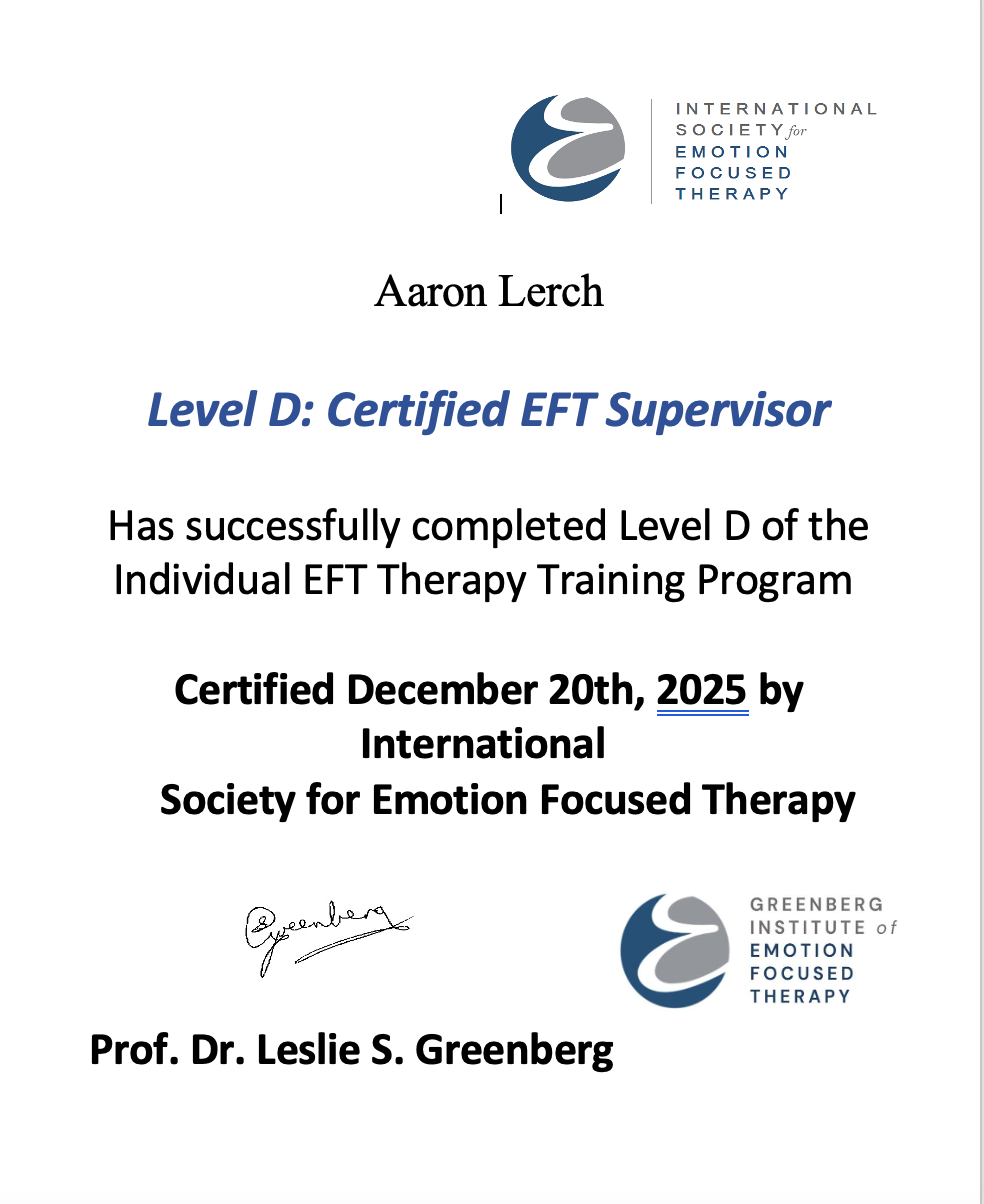
I am certified to supervise therapists in Emotion-Focused Therapy under ISEFT guidelines.
If the approach described here resonates with your experience, you can learn more about the therapeutic work on the Work page or get in touch through the Contact page.